
What is Section 20?
If you live in or help manage a leasehold development, you may have heard the term “Section 20” when substantial repairs or maintenance are being considered.
Section 20 refers to the consultation requirements contained in the Landlord and Tenant Act 1985. They are designed to give leaseholders information about certain proposed expenditure and an opportunity to comment before the costs are incurred.
In Wales, consultation is generally required where qualifying works will result in any one leaseholder being required to contribute more than £250 through the service charge.
What Sort of Work Can Require Section 20 Consultation?
There is no fixed list of “major works”. The important questions are whether the proposed works are qualifying works and how much each leaseholder will be required to contribute.
Depending on the development and the terms of the lease, examples can include roof repairs or replacement, external decoration, communal doors, drainage works, roads and pathways and other substantial repairs to the building or estate.
The lease should always be checked first. It determines what the landlord or management company is responsible for and whether the cost can be recovered from leaseholders through the service charge.
Why Does the £250 Figure Matter?
A common misunderstanding is that Section 20 applies when the total contract costs more than £250.
It doesn’t.
The relevant test for qualifying works is whether the amount payable by any one leaseholder will exceed £250.
For example, a £4,000 project shared equally between 20 leaseholders would result in a contribution of £200 each and would not cross the £250 threshold on those figures.
But a £4,000 project shared between 10 leaseholders would result in a contribution of £400 each, meaning Section 20 consultation may be required.
The Section 20 Consultation Process
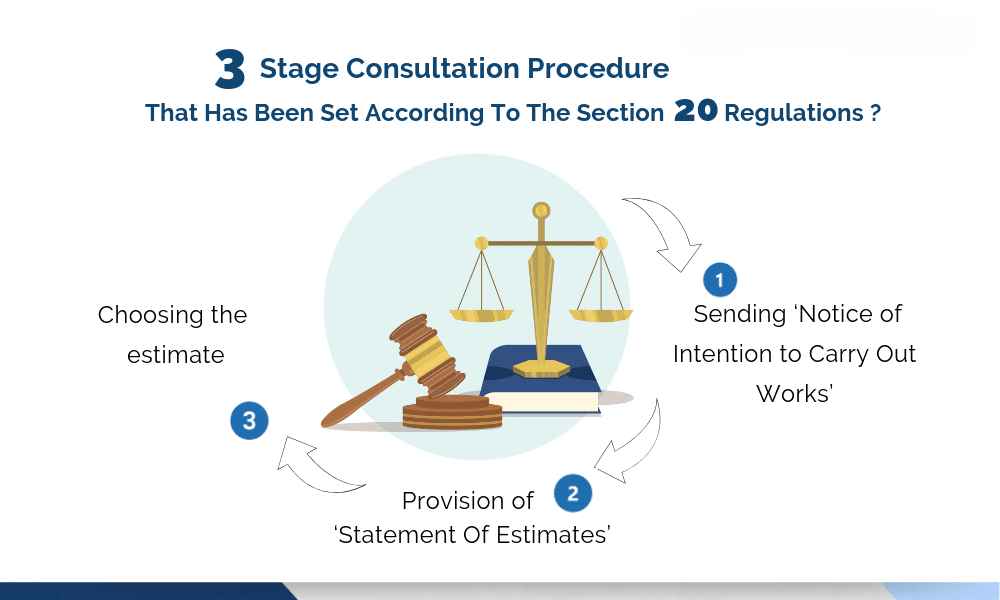
For the usual qualifying-works procedure where a public notice is not required, there are normally two consultation stages before the contractor is appointed.
The first is the Notice of Intention. This explains the proposed works and why they are considered necessary. Leaseholders are given at least 30 days to make written observations and, where the procedure permits, nominate a contractor from whom an estimate should be sought.
The second stage provides information about the estimates obtained. At least two estimates are normally included in the statement, and leaseholders are given a further period of at least 30 days in which to make observations. The landlord must have regard to observations received during the consultation.
There can then be a further Notice of Reasons after the contract is awarded. This is required in certain circumstances, including where the selected contractor did not submit the lowest estimate and was not a leaseholder nominee.
This is why Section 20 consultation cannot normally be completed in a few days.
Does the Cheapest Contractor Have to Be Chosen?
No.
Section 20 does not simply require the management company or landlord to choose the cheapest quotation.
There may be legitimate reasons for selecting another contractor, including the proposed specification, relevant experience, insurance, availability or the contractor’s ability to undertake the particular project.
However, where the selected contractor is neither a leaseholder nominee nor the contractor who provided the lowest estimate, the legislation requires the decision to be explained to leaseholders.
Can Leaseholders Stop the Works?
Section 20 consultation gives leaseholders the opportunity to make observations about the proposed works and, in appropriate circumstances, nominate a contractor.
It does not give individual leaseholders a veto over necessary works.
The landlord or management company must have regard to observations received, but necessary works can still proceed. Leaseholders retain separate rights to challenge matters such as the reasonableness of service charges.
What Happens if Section 20 Is Not Followed?
This can have serious financial consequences.
If consultation was required but the statutory procedure was not followed, recovery is generally limited to £250 from each leaseholder for the qualifying works, unless the landlord obtains dispensation from the relevant tribunal.
That is one reason management companies and directors should identify whether Section 20 applies before instructing substantial works.
There are circumstances where urgent works cannot reasonably wait for the normal consultation process. In appropriate cases, an application can be made to the tribunal for dispensation from some or all of the consultation requirements.
Section 20 Doesn’t Replace the Lease
Section 20 is only part of the picture.
Before major works are undertaken, the lease should be reviewed to establish responsibility for the work, whether the expenditure can be recovered through the service charge and how each leaseholder’s contribution should be calculated.
The existence of a Section 20 consultation does not itself create a right to charge leaseholders for something that the lease does not permit.
Planning Major Works Properly
Good major works management involves considerably more than issuing the statutory notices.
Depending on the project, it may involve preparing a suitable specification, obtaining competitive tenders, appointing surveyors or other professionals, checking contractor insurance and health and safety documentation, communicating with residents and monitoring the works through to completion.
For RMC and RTM directors, planning early is particularly important. Section 20 consultation takes time and should be incorporated into the project timetable rather than treated as something to address immediately before work is due to start.