
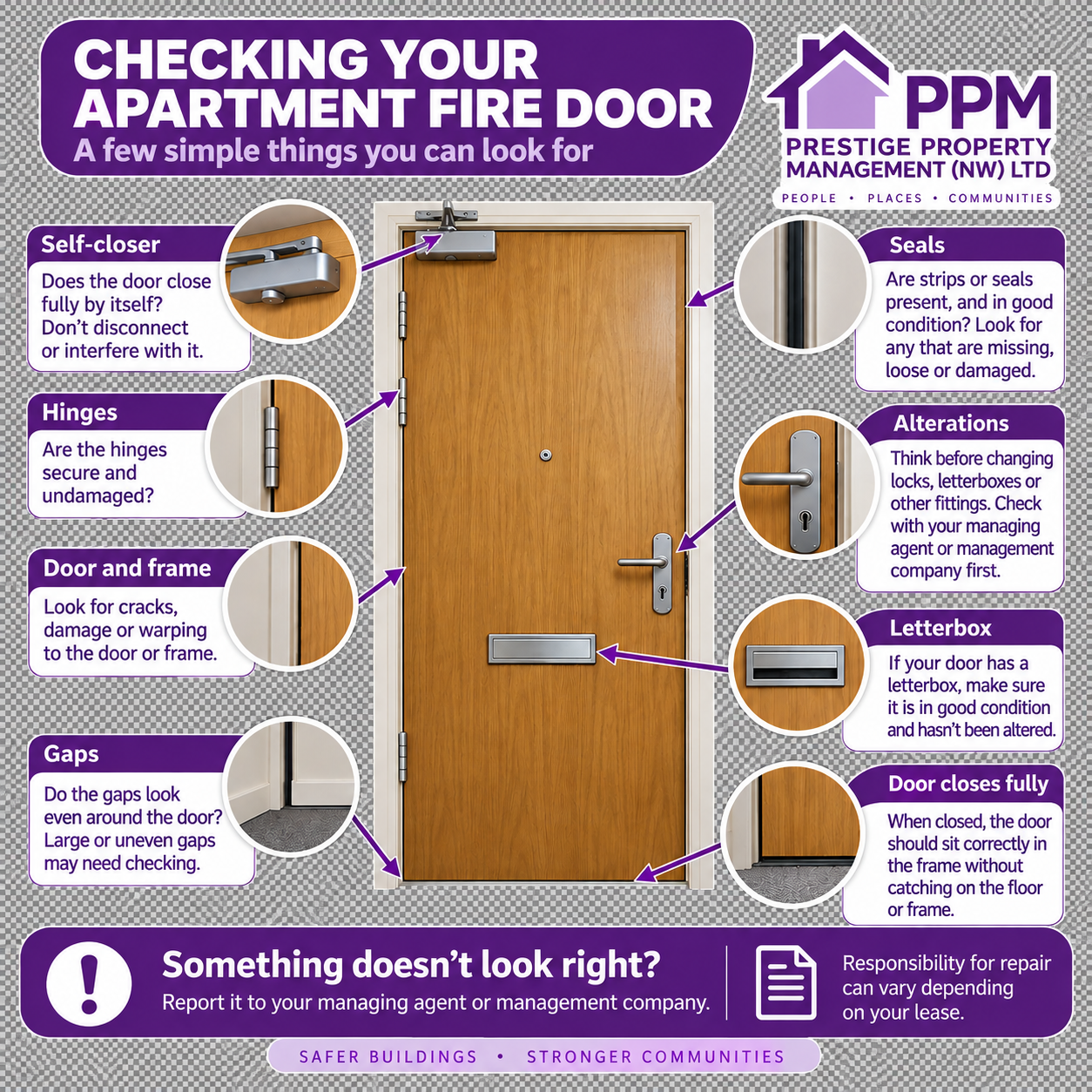
Checking Your Apartment Fire Door: A Simple Guide for Residents
Your apartment entrance door may look like any other front door, but in many apartment buildings it is also an important part of the building’s fire safety measures.
A suitable fire-resisting entrance door can help prevent fire and smoke spreading from an apartment into communal corridors, stairways and escape routes.
Formal fire door inspections should be undertaken by an appropriately competent person where required, but residents can also keep an eye on their own entrance door and report anything that doesn’t look right.
Who is responsible for your apartment fire door?
This is an important question because responsibility can differ from one development to another.
In some buildings, responsibility for apartment entrance doors may rest with the landlord, management company or RTM company.
In other developments, the entrance door forms part of the individual apartment owner’s demise under the lease. In those circumstances, the leaseholder may be responsible for maintaining, repairing and, where necessary, replacing their own fire door.
The lease should therefore be checked before assuming who is responsible for the door or for the cost of any necessary work.
However, even where an apartment entrance door is the leaseholder’s responsibility, it can still form an important part of the overall fire safety arrangements for the building.
This means owners should not make alterations to a fire door simply because the door belongs to them.
Important: Responsibility for apartment entrance doors is not the same at every development. The lease should always be checked before assuming responsibility rests with the management company or the individual apartment owner.
1. Does your door close properly?
If your apartment entrance door has a self-closing device, try opening the door and allowing it to close by itself.
It should close fully into the frame without needing to be pushed or pulled shut.
Look out for a door that:
stops before it reaches the frame;
catches on the floor;
sticks against the frame;
doesn’t engage properly when it closes; or
has a self-closing device that appears damaged or disconnected.
A fire door that doesn’t close properly may not be able to perform as intended in the event of a fire.
2. Look at the condition of the door and frame
You don’t need to be a fire door specialist to notice obvious damage.
Take a look at the door, frame and surrounding components and watch for:
cracks, splits or holes;
damage to the door frame;
loose or damaged hinges;
damaged glazing;
a door that appears warped;
areas where locks or fittings have been removed or altered; or
anything else that looks noticeably different or damaged.
If you’re concerned, report it rather than attempting to repair it yourself.
3. Look at the gaps around the door
Close the door and look around the top and sides.
The gaps should appear relatively even. Large or noticeably uneven gaps can be a sign that the door needs further investigation.
Also look at the bottom of the door. It needs to be able to close freely without catching, but an excessive gap may also need to be assessed.
Residents aren’t expected to carry out technical measurements or decide whether a fire door is compliant. If something looks wrong, report it.
4. Check the seals
Depending on the type and age of the fire door, you may see strips or seals fitted around the edge of the door or within the frame.
Look for anything that is:
missing;
loose;
damaged;
torn;
coming away from the door or frame; or
heavily covered with paint.
Don’t remove, cut or replace seals yourself unless the appropriate specification has been established.
It is also important not to assume that an older door is automatically defective simply because it doesn’t look like a modern fire door. If there is uncertainty about its suitability, it should be professionally assessed.
5. Don’t disconnect the self-closer
A self-closing device can be inconvenient when you’re carrying shopping through the door, but it performs an important function.
If the door is intended to self-close, don’t disconnect, remove or interfere with the closing device.
And don’t wedge a fire door open.
If the closer is excessively heavy, slams the door, doesn’t close it properly or appears faulty, report the problem rather than adjusting it yourself.
6. Think before changing locks or fittings
Even relatively small alterations can potentially affect a fire door.
Before drilling into or altering your apartment entrance door, check whether permission or a particular specification is required.
This can include fitting or changing:
locks;
letterboxes;
door viewers;
glazing;
security devices;
smart locks;
chains or additional door furniture.
If you’re unsure, ask before carrying out the work.
7. Don’t simply replace your front door
If you’re refurbishing your apartment, you might be tempted to replace the entrance door because you prefer a different design.
An apartment entrance fire door is not the same as an ordinary internal door.
The replacement may need to meet particular fire-resistance and smoke-control requirements, and your lease may require consent before the door can be changed.
Always check with your managing agent, management company or landlord before ordering or replacing an apartment entrance door.
What if the fire door is the apartment owner’s responsibility?
If your lease makes you responsible for the entrance door, that doesn’t mean concerns about its fire performance can simply be ignored.
You may be responsible for arranging and paying for appropriate repairs or replacement.
Where work is required, it is important to establish what specification is needed before instructing a contractor. Depending on the circumstances, the management company or managing agent may also require information about the proposed works before they are carried out.
Something doesn’t look right? Report it.
Contact your managing agent, landlord or management company if your apartment entrance door:
isn’t closing properly;
has obvious damage;
has a faulty or damaged self-closer;
is catching on the floor or frame;
has noticeably large or uneven gaps;
has damaged or missing seals;
appears to have been altered; or
simply gives you cause for concern.
They can then establish the appropriate next step and, where necessary, check who is responsible under the lease for arranging and paying for any remedial work.
Fire safety is a shared responsibility
Residents aren’t expected to become fire door inspectors.
However, you see and use your apartment entrance door every day. Spotting a problem and reporting it promptly can help ensure that defects are investigated rather than remaining unnoticed until the next formal inspection.
If Prestige Property Management (NW) Ltd manages your development and you have concerns about your apartment entrance fire door, please report them to our team. We can review the management arrangements and relevant lease provisions and advise on the appropriate next step, including whether responsibility for the door rests with the individual apartment owner.