
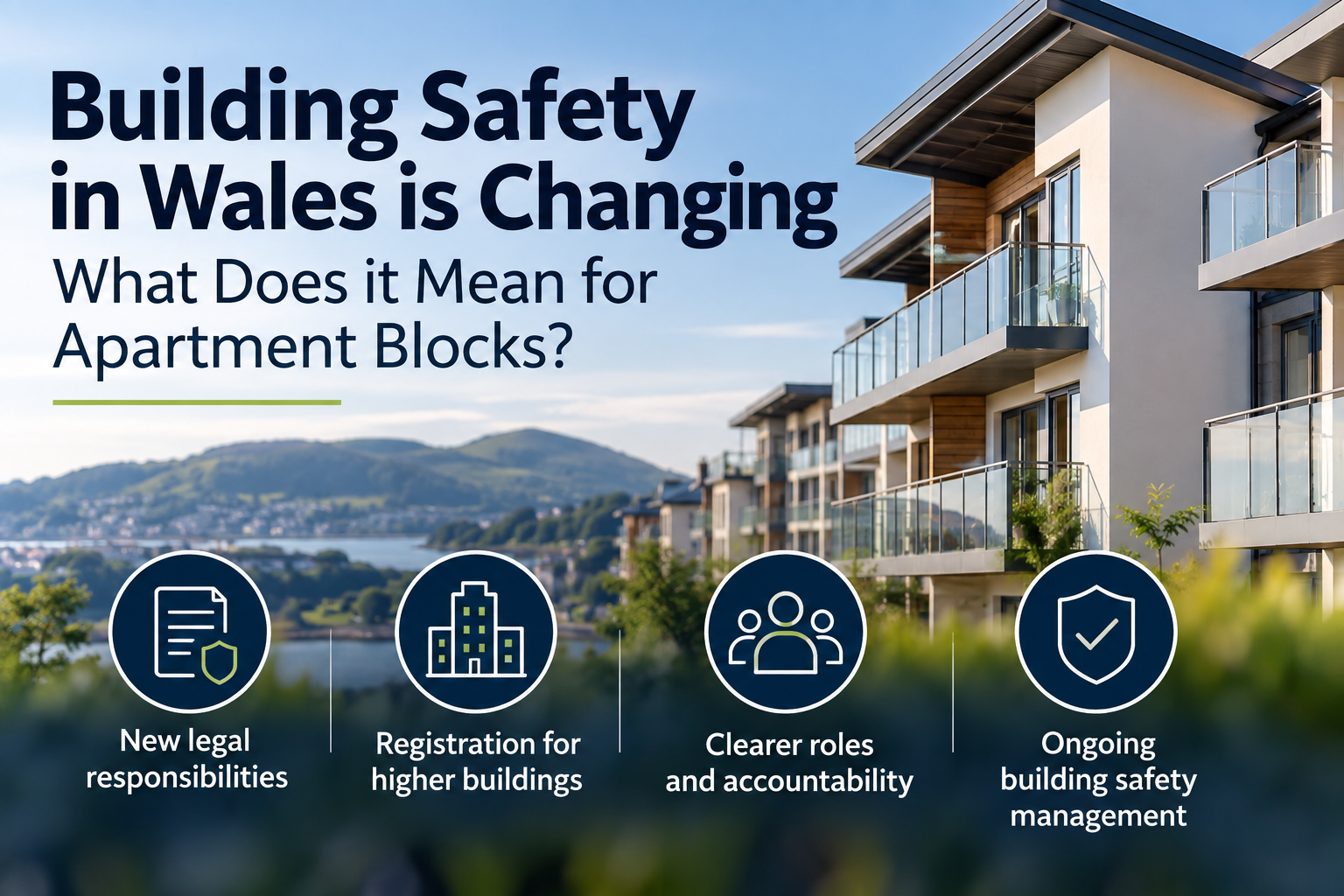
Building safety regulation in Wales is moving another step closer to implementation.
On 24 September 2026, the Welsh Government launched a new consultation on regulations under the Building Safety (Wales) Act 2026.
The latest consultation looks at three important areas:
- how the Principal Accountable Person will be determined;
- registration of Category 1 and Category 2 buildings with Building Safety Authorities; and
- the fees that Building Safety Authorities will be able to charge.
The consultation remains open until 18 December 2026.
For directors of Residents’ Management Companies (RMCs), Right to Manage (RTM) companies and others involved in managing apartment buildings in Wales, this is worth paying attention to.
The new regime is about much more than carrying out a fire risk assessment. It introduces clearer legal responsibilities for the ongoing management of building safety during the occupation of residential buildings.
Which buildings are affected?
One of the important differences between the Welsh regime and the system introduced in England is its breadth.
The Building Safety (Wales) Act establishes a new regime for multi-occupied residential buildings containing two or more residential units, although the duties vary according to the category of building.
The Act creates three categories of regulated building.
Category 1 covers the highest buildings – those at least 18 metres high or with at least seven storeys.
Category 2 covers buildings below 18 metres and fewer than seven storeys, but which are at least 11 metres high or have at least five storeys.
Category 3 covers lower-rise regulated buildings.
Some of the more extensive requirements apply to Category 1 and Category 2 buildings. For example, buildings that are at least 11 metres high or have at least five storeys will be required to register with a Building Safety Authority.
However, that does not mean directors of smaller apartment developments can ignore the legislation.
The Act introduces duties relating to the assessment and management of fire safety risks across in-scope buildings, while structural safety duties apply to the higher categories.
Who is actually responsible?
This is where the new legislation becomes particularly important for management companies and their directors.
The Act introduces the roles of the Accountable Person and, where appropriate, the Principal Accountable Person.
Responsibility will depend upon the legal arrangements for the individual building.
That means it should not simply be assumed that the managing agent is the Accountable Person because they deal with the day-to-day management of the development.
Likewise, the name of the management company appearing on correspondence does not necessarily answer the question.
The leases, ownership structure and repairing responsibilities of the development all need to be understood.
The Welsh Government’s latest consultation is considering the detailed rules for determining who will be the Principal Accountable Person where more than one Accountable Person exists.
This is another reason why understanding the legal structure of a development matters.
What is the managing agent’s role?
A professional managing agent will have an important role in helping clients manage their responsibilities.
That may include coordinating fire risk assessments and other specialist inspections, maintaining records, monitoring actions, arranging remedial works, communicating with residents and ensuring important matters are brought to the attention of directors.
But there is an important distinction between managing the building on behalf of a client and holding the statutory responsibility imposed by legislation.
Good management therefore starts with understanding who is responsible for what.
Where specialist fire, structural or legal advice is required, the appropriate competent professional should also be involved.
Registration is coming for higher buildings
Under the new regime, Category 1 and Category 2 buildings will need to be registered with their relevant Building Safety Authority.
The current consultation considers how that registration system should operate, including the information that will need to be supplied and the fees that may be charged.
This is particularly relevant for management companies responsible for larger apartment developments.
Although much of the detailed implementation will come through regulations and guidance, directors do not need to wait until the final deadline to start understanding their building.
Basic information such as building height, number of storeys, ownership structure, leases, fire safety information and repairing responsibilities is likely to become increasingly important.
Building safety is becoming an ongoing management responsibility
Perhaps the biggest change is the move away from thinking about building safety as a collection of individual certificates and inspections.
The Welsh regime is intended to create clearer accountability for the ongoing assessment and management of building safety risks.
That means identifying risks, recording information, acting on recommendations and being able to demonstrate what has been done.
For managing agents and directors, good record keeping and clear decision-making will therefore become increasingly important.
This links closely with something we discussed in our recent article on good governance.
A report sitting in a file is only part of the process.
If an assessment identifies work that needs to be undertaken, somebody needs to understand the recommendation, decide what action is required, arrange the work where appropriate and retain a record of what happened.
Residents also have a stronger voice
The legislation is not solely about landlords, management companies and managing agents.
The new framework also provides residents with stronger rights relating to building safety information and concerns, alongside responsibilities of their own.
For those managing residential buildings, clear communication with residents will therefore become an increasingly important part of building safety management.
Residents should know how to raise a safety concern and have confidence that genuine concerns will be considered appropriately.
What should RMC and RTM directors be doing now?
There is no need to panic or start implementing requirements that have not yet come into force.
Much of the detailed framework is still being developed through secondary legislation and guidance.
But there is a difference between waiting for the regulations and being unprepared for them.
This is a sensible time for directors and managing agents to make sure they understand their buildings.
That means knowing what fire and building safety information is already held, whether assessments and inspections are up to date, what actions remain outstanding and who has responsibility for the different parts of the building.
For larger developments, it is also worth establishing whether the building is likely to fall within Category 1 or Category 2 and therefore become subject to the registration requirements.
PPM will continue to follow the changes
At Prestige Property Management (NW) Ltd, we manage residential developments across North Wales and will continue to follow the implementation of the Building Safety (Wales) Act 2026 as the detailed regulations and guidance emerge.
Our approach is straightforward: understand the requirements, explain them clearly to our clients and make sure directors have the information they need to make informed decisions.
There will undoubtedly be more detail to come as the new regime is implemented.
For now, the important message for RMC and RTM directors is simple:
Building safety in Wales is changing, and understanding your building, your responsibilities and the information you already hold is the best place to start.
Welsh Government consultation
This article provides general information about the developing building safety regime in Wales and should not be regarded as legal or specialist fire or structural safety advice.