
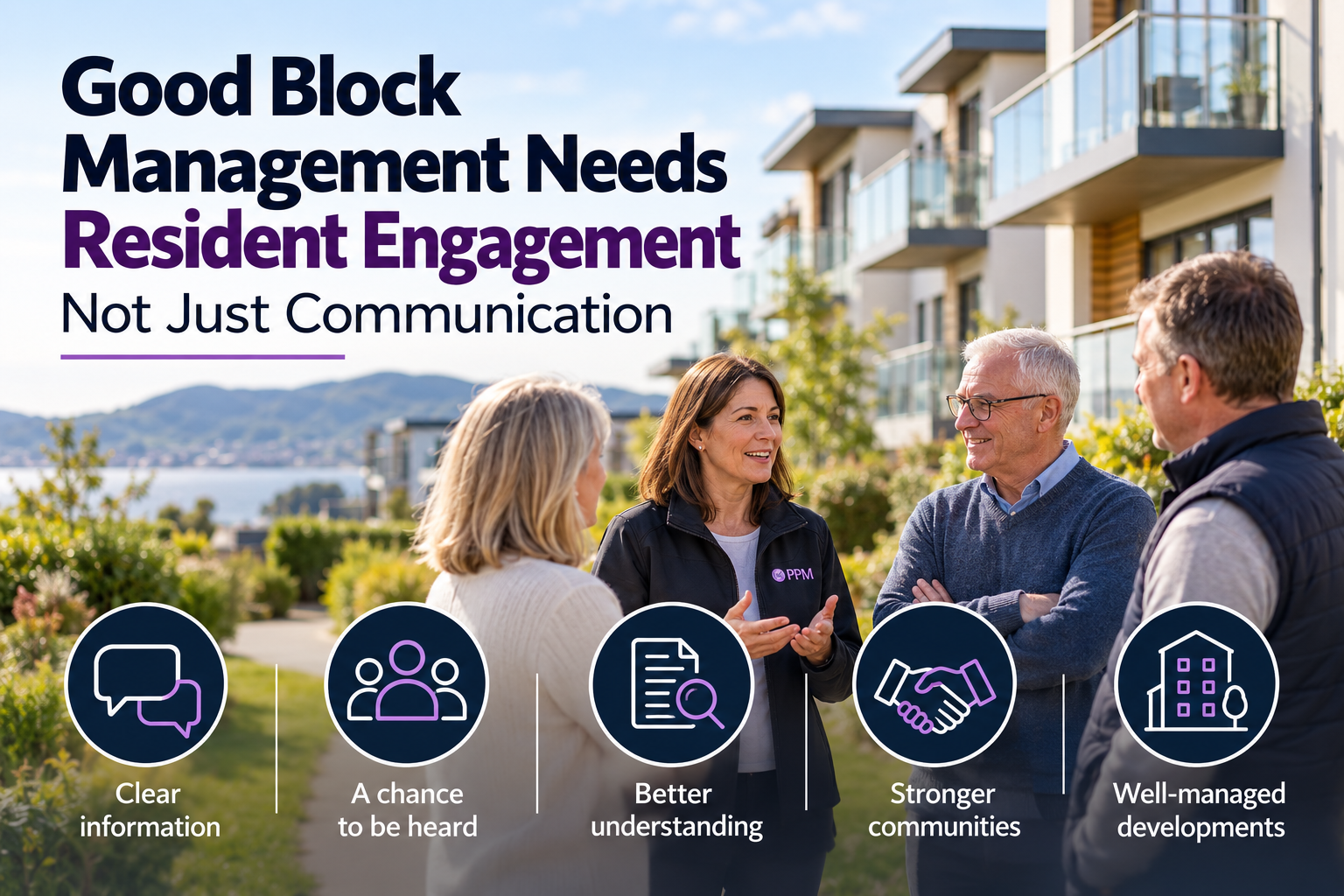
Good communication is something every managing agent promises.
But good block management should go further than simply sending emails, issuing notices and circulating meeting minutes.
It should also involve resident engagement.
This is particularly topical in Wales. On 23 September 2026, the Welsh Government agreed proposals for the establishment of a National Resident and Leaseholder Engagement Forum for Wales.
It reflects a wider direction in residential property management: residents and leaseholders should be appropriately informed, have clear ways to raise concerns and, where appropriate, have an opportunity to contribute to discussions about their homes.
But what does meaningful resident engagement actually look like in a privately managed apartment development?
And, equally importantly, what doesn’t it mean?
Communication and engagement are not quite the same thing
Communication is often one-way.
The managing agent tells residents that contractors are attending, provides information about planned works, sends service charge information or circulates an update from the directors.
All of that is necessary.
Engagement is slightly different.
It means giving residents an appropriate opportunity to ask questions, raise concerns, understand why something is happening and, where appropriate, contribute information that may help directors and the managing agent make better-informed decisions.
That doesn’t mean every issue needs a meeting or consultation.
Sometimes a straightforward update is exactly what is required.
The important thing is knowing the difference.
Resident engagement doesn’t mean management by committee
This distinction is particularly important in Residents’ Management Companies (RMCs) and Right to Manage (RTM) companies.
A development may contain 20, 50 or 100 leaseholders, all with different priorities and opinions.
That does not mean every management decision can – or should – be made by asking everyone what they would prefer.
The company has directors.
Those directors have responsibilities for making decisions on behalf of the company within the authority available to them.
The managing agent supports those directors with information, advice and day-to-day management.
And sitting behind both is the lease, the company’s Articles of Association and the relevant legal framework.
Resident engagement does not override any of those things.
Sometimes the right decision won’t be the most popular one
This is one of the realities of block management.
Most people understandably want service charges kept as low as possible.
But a building still needs to be insured, maintained and managed. Compliance requirements have to be addressed. Contracts need to be paid. Repairs cannot always be postponed.
Likewise, directors may receive professional advice recommending work that residents would rather not pay for.
Good engagement means explaining what has been recommended, why it matters, what the options are and, where appropriate, listening to residents’ concerns.
It does not mean that necessary work automatically disappears because it is unpopular.
There is an important difference between listening to people and promising that everybody will get the outcome they want.
The lease still matters
Many disagreements in block management ultimately come back to the lease.
Who is responsible for a particular repair?
Can the cost be recovered through the service charge?
How should costs be apportioned?
Who maintains a particular part of the building?
What alterations require consent?
These questions cannot always be resolved by a majority vote or by deciding what seems fairest.
The starting point is usually the legal documentation governing the development.
That is why good resident engagement should also involve clear explanations.
Where the lease determines the position, residents should be told that – and, where possible, have the position explained in understandable language.
Directors need to be able to make decisions
Directors of RMC and RTM companies can sometimes find themselves in a difficult position.
They may live alongside the people affected by their decisions. They may see those people every day. And they are often volunteers.
It can therefore be tempting to delay a difficult decision until everyone agrees.
In reality, unanimous agreement may never come.
Good governance and good engagement should work together.
Directors should have the information they need. Residents should be appropriately informed. Relevant concerns should be considered. Professional advice should be obtained where necessary.
Then somebody still has to make the decision.
Engagement can also improve management
This shouldn’t all sound negative.
Residents often know their development extremely well.
They may notice a recurring leak before it appears during a scheduled inspection, know that an entrance door is regularly being left open or spot a problem with lighting, drainage or communal areas before the managing agent becomes aware of it.
A sensible route for reporting issues can therefore help problems to be identified earlier.
Residents can also provide useful information when major works are being planned.
Welsh Government guidance on fire-safety remediation, for example, emphasises regular communication, meaningful engagement and understanding how works may affect the people actually living in the building.
That is a good principle beyond major remediation projects too.
Clear communication prevents unnecessary frustration
One of the simplest improvements any development can make is to establish who communicates what.
Residents should know where to report repairs.
Leaseholders should know where service charge enquiries should be directed.
Directors should understand which matters need board decisions.
The managing agent should know when an issue needs to be escalated to the directors or to a specialist professional.
And when an important decision has been made, people affected by it should receive a clear explanation where appropriate.
A surprising amount of conflict in block management comes not from the original problem, but from uncertainty about what is happening next.
Plain English matters
Property management inevitably involves technical terminology.
Leases, Section 20 consultation, fire risk assessments, reserve funds, service charge apportionments, company Articles and statutory obligations are not everyday subjects for most residents.
There is little value in sending somebody a technically correct explanation if they cannot understand what it means.
At Prestige Property Management (NW) Ltd, we believe part of a managing agent’s role is to make complicated information understandable.
That doesn’t mean oversimplifying important legal or technical issues.
It means explaining them clearly and knowing when specialist legal, surveying, fire-safety or other professional advice is required.
Good engagement is about balance
Good block management shouldn’t mean residents only hear from their managing agent when there is a problem or a bill to pay.
But neither should managing a development become an endless attempt to obtain unanimous agreement about every decision.
The balance is somewhere between the two.
Communicate clearly.
Listen appropriately.
Explain the reasons behind important decisions.
Follow the lease and legal framework.
Give directors the information they need to make informed decisions.
And make sure residents know how to raise genuine concerns.
That is meaningful resident engagement.
And ultimately, it helps create developments where residents, directors and managing agents have a clearer understanding of their respective roles.
At PPM, that’s the approach we believe good residential block management should take.
This article provides general information about residential property management and should not be regarded as legal advice.